No new road capacity
Williamson County appears four times in the state's ten-year road plan, for $422.6 million. Not one of those projects is scheduled to break ground before 2032.
A fifteen-year forecast
The Next Fifteen Years Are Already Written.
This Is How to Read Them.
Williamson County has quietly made itself impossible to reproduce. This is the evidence — assembled from documents anyone can read, and almost nobody has read together.

The argument
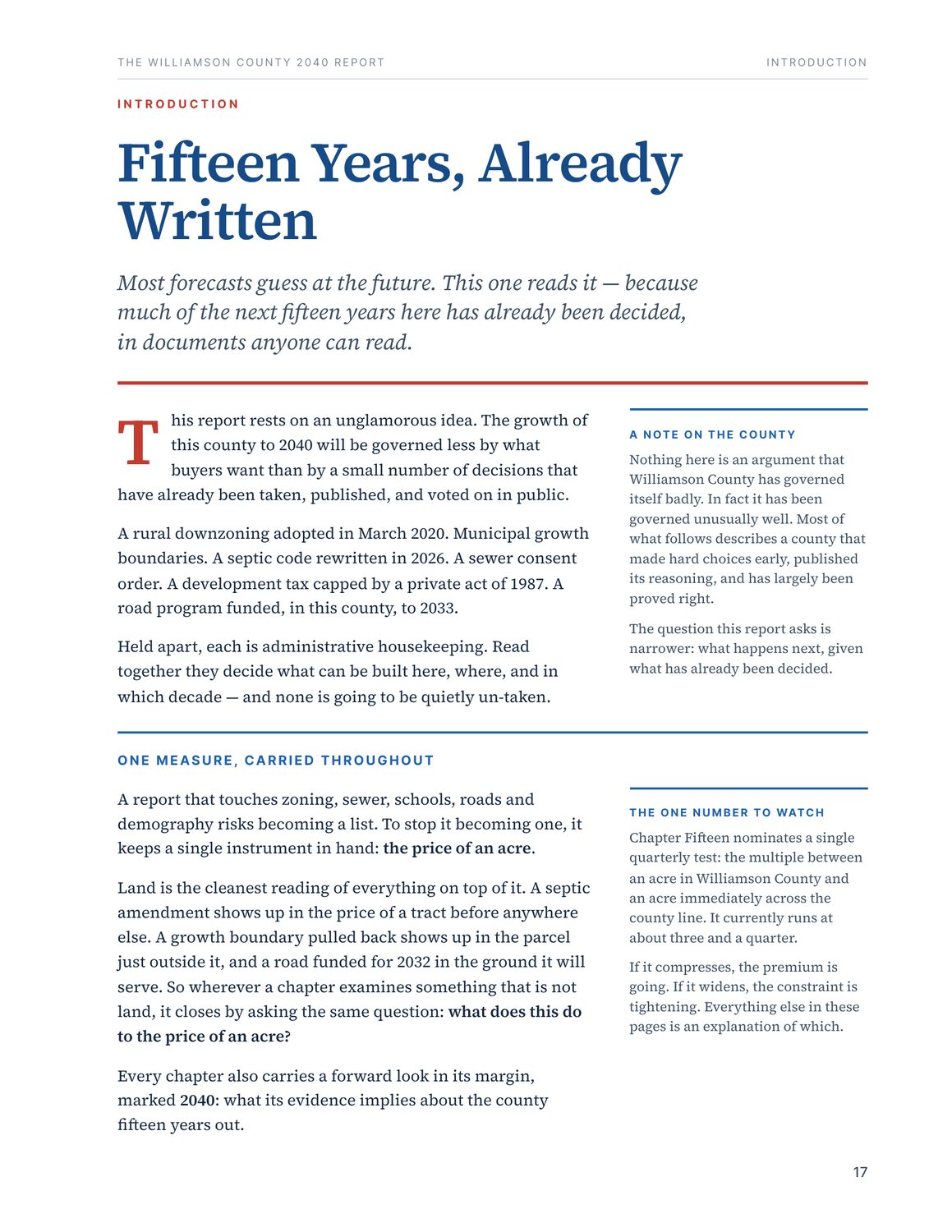
Most forecasts guess at the future. This one reads it — because a great deal of the next fifteen years in Williamson County has already been decided, in documents anyone can read.
A rural downzoning adopted in March 2020. A set of municipal growth boundaries. A septic code rewritten in 2026. A sewer consent order. A development tax capped by a private act of 1987. A road program funded, in this county, to 2033. Held apart, each is administrative housekeeping. Read together, they decide what can be built in Williamson County, where, and in which decade — and not one of them has reversed in six years.
The report assembles those documents into a single argument and follows it through twenty-one chapters, using one instrument throughout: the price of an acre.
Homes of rural capacity the county published, then removed within the year
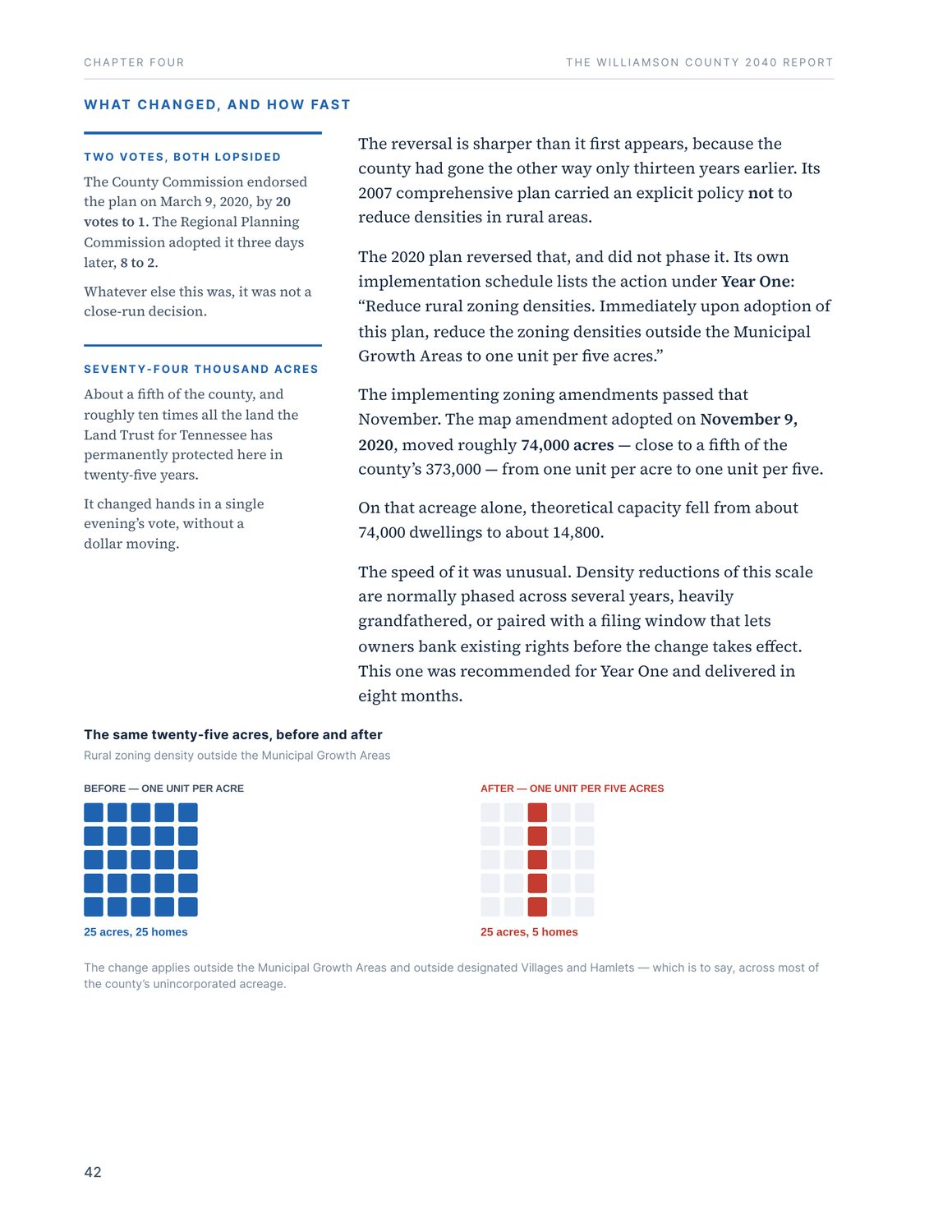
Acres moved from one unit per acre to one per five, in a single evening's vote
Homes permitted last year, against about 32,000 households coming
Sales above $5m in 2025, up from $171.6m in 2023 — through a rate shock
A story about supply
Six constraints, all of them recorded, all of them dated. None has reversed.
Williamson County appears four times in the state's ten-year road plan, for $422.6 million. Not one of those projects is scheduled to break ground before 2032.
The county owns no sewer plant, and its drinking water is treated in another county. Only one of those facts decides where growth can physically go.
In March 2020 the county published the capacity it was about to remove, gave its reasons, and removed it within the year — across about a fifth of its acreage.
One city cannot connect new sewer at all under a state consent order. A town of nine thousand rations capacity by reservation and prepaid fee.
The development tax is capped by a private act of 1987. Four fifths of Franklin's general fund comes from what people buy, not from what they own.
The tax code, the deed and the timing of a generation all pull the same way. The binding constraint is not what the zoning allows — it is how few owners have any reason to sell.
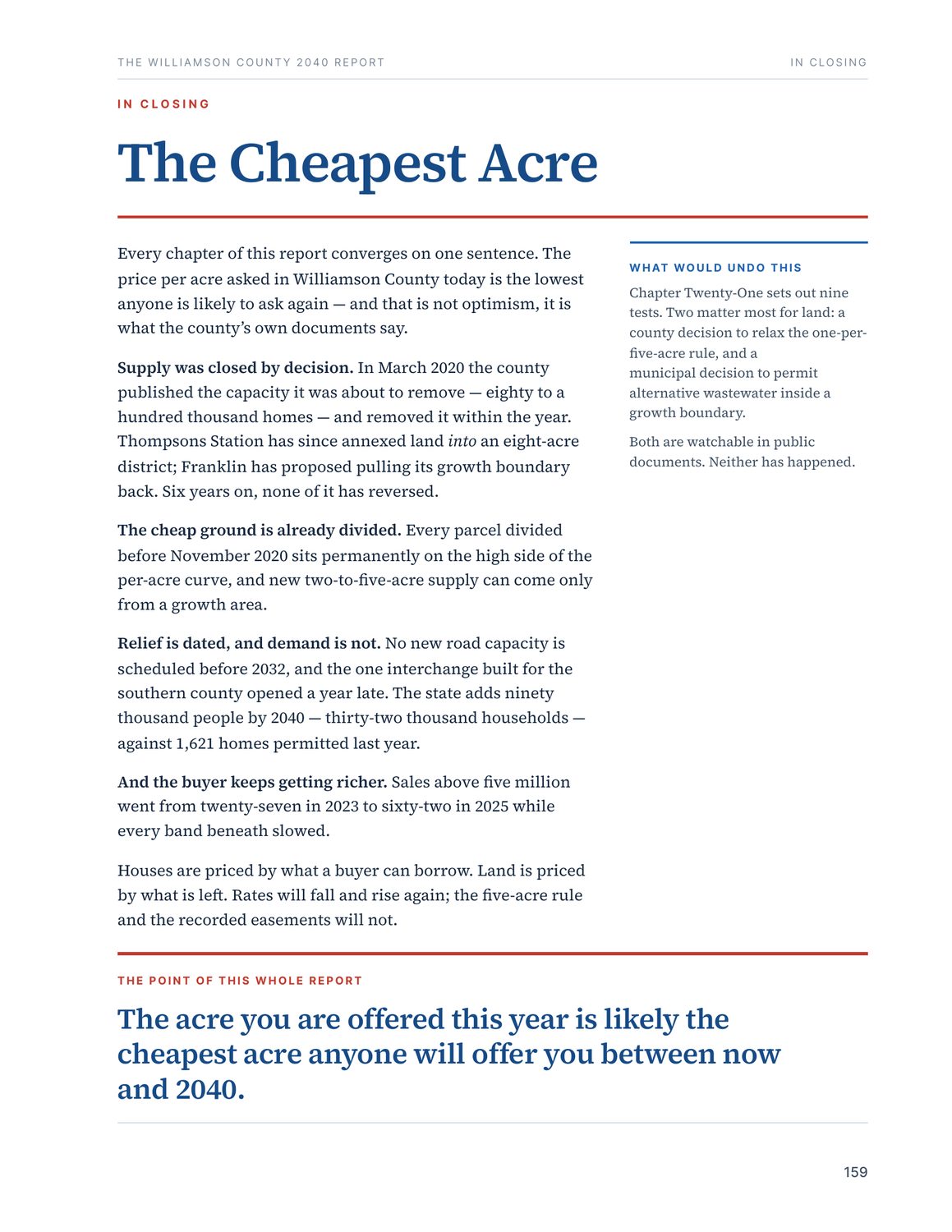
Zoning is a decision. Capacity is a fact. Decisions can be revisited. Facts have to be built.
Who this report is for
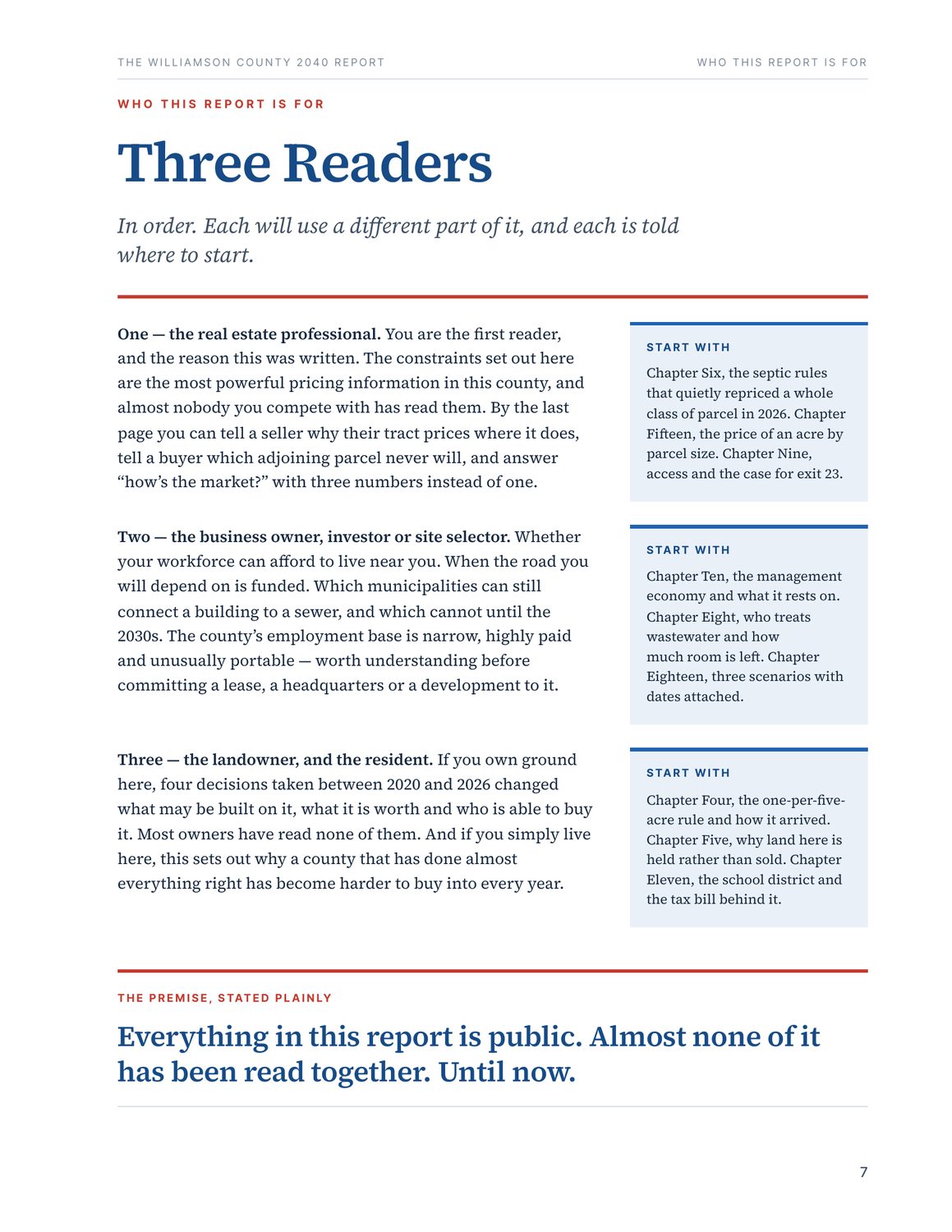
Each will use a different part of it, and each is told where to start.
You are the first reader, and the reason this was written. The constraints set out here are the most powerful pricing information in this county, and almost nobody you compete with has read them. By the last page you can tell a seller why their tract prices where it does, tell a buyer which adjoining parcel never will, and answer "how's the market?" with three numbers instead of one.
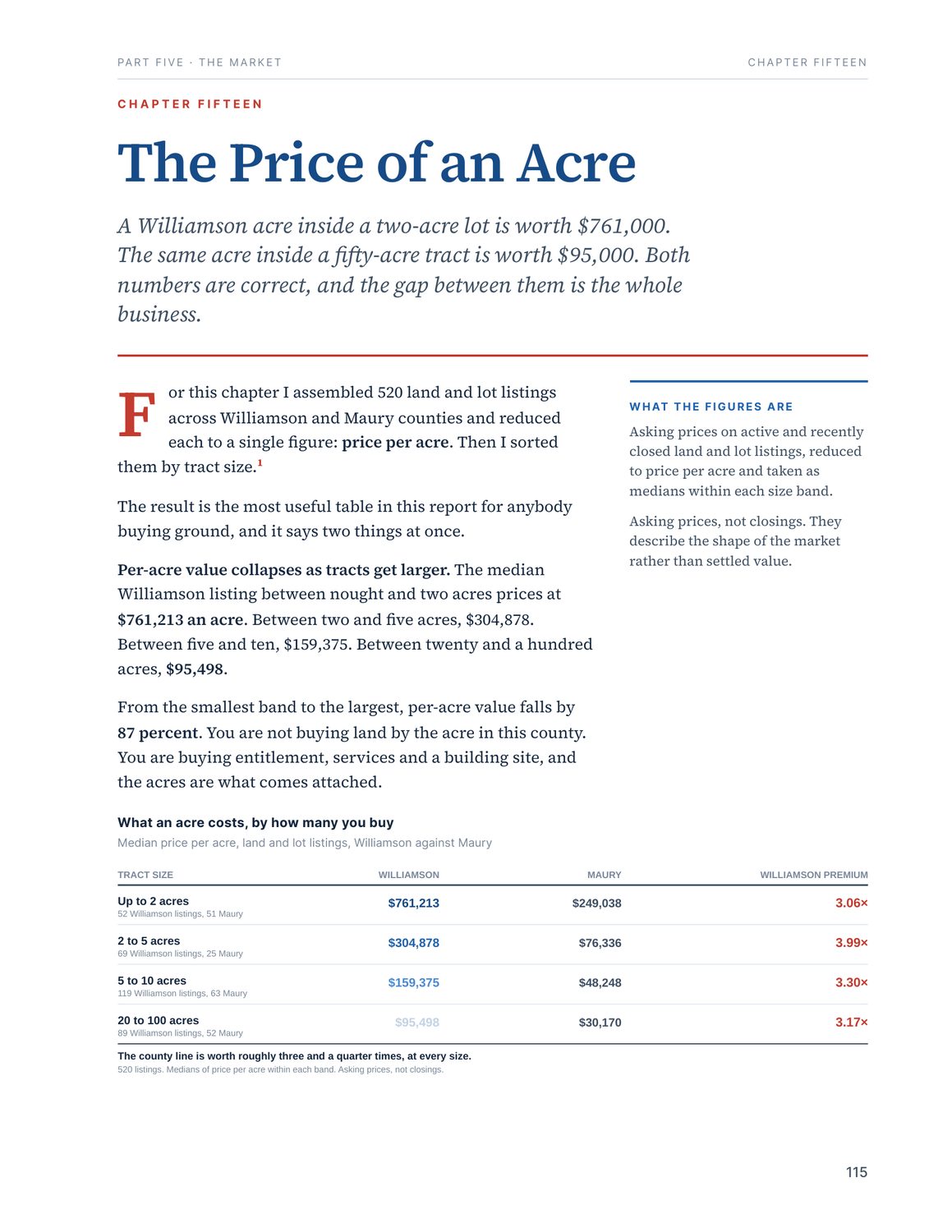
Chapter Six, the septic rules that quietly repriced a whole class of parcel in 2026. Chapter Fifteen, the price of an acre by parcel size. Chapter Nine, access and the case for exit 23.
Whether your workforce can afford to live near you. When the road you will depend on is funded. Which municipalities can still connect a building to a sewer, and which cannot until the 2030s. The county's employment base is narrow, highly paid and unusually portable — worth understanding before committing a lease, a headquarters or a development to it.
Chapter Ten, the management economy and what it rests on. Chapter Eight, who treats wastewater and how much room is left. Chapter Eighteen, three scenarios with dates attached.
If you own ground here, four decisions taken between 2020 and 2026 changed what may be built on it, what it is worth and who is able to buy it. Most owners have read none of them. And if you simply live here, this sets out why a county that has done almost everything right has become harder to buy into every year.
Chapter Four, the one-per-five-acre rule and how it arrived. Chapter Five, why land here is held rather than sold. Chapter Eleven, the school district and the tax bill behind it.
Look inside
Six pages from the first edition, at full size.
Selected lines
Contents
An introduction, twenty-one chapters and two closing pages. 164 pages, 8.5 × 11 inches. Click any chapter to open it in the online edition — $49, access is immediate.
The edition
The standard it holds itself to
The report is modelled on Melbourne 2030, a metropolitan plan published in 2002 with a thirty-year horizon and numerical targets its authors were prepared to be judged on. Chapter Seventeen scores those targets against what actually happened. The lesson is that plans fail in predictable places — rarely in the vision, almost always in the machinery meant to deliver it.
This report then submits to the same standard. Chapter Twenty sets out every condition under which it would be wrong, and the public document where each would first appear.
Every decision that could break this forecast will be taken in public, on a published agenda, by a body you can watch.
Sources
Adopted plans and ordinances · state road programs · census tables · audited annual financial reports · utility filings and consent orders · multiple-listing closed-sale records · the United States Census of Agriculture · Tennessee Comptroller reports. Where a figure is the author's own calculation, or a compilation rather than an official count, the footnote says so.
Order
Hardcover · $100
164 pages, 8.25 × 11 inches, case bound on premium colour paper.
ISBN 979-8-9981394-2-0
Paperback · $79
164 pages, 8.5 × 11 inches, perfect bound with a gloss cover.
ISBN 979-8-9981394-0-6
Online edition · $49
The complete report in your browser, on any device, searchable by chapter. Access is immediate and does not expire.
Read online — not a download
One email when there is something worth sending — a revision, a data update, or the next report. Nothing else.
Your address is used for these updates only, and never passed on.
Brokerages, planning bodies and firms wanting multiple copies — get in touch directly.
Which is the point of all of it
None of it was hidden.
It was only unread.